
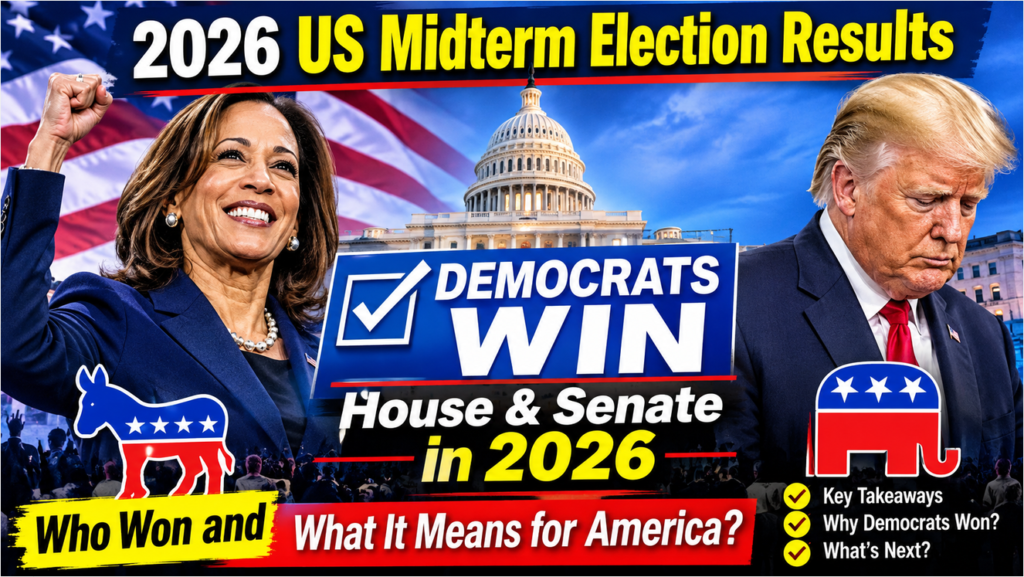

The 2026 US midterm elections brought a major change to American politics. On November 3, 2026, voters across the United States participated in congressional, gubernatorial, and other state and local elections. The results delivered a significant victory for the Democratic Party, which gained control of both the US House of Representatives and the Senate.
According to reporting by the Associated Press and Reuters on November 4, Democrats made substantial gains in several traditionally Republican states. The results reflected voter concerns about the cost of living, President Donald Trump’s leadership, the war involving Iran, and the direction of the federal government.
The outcome represents a major political setback for Republicans and creates a new challenge for the Trump administration. With Democrats preparing to take control of both chambers of Congress in January 2027, disagreements over federal spending, healthcare, immigration, foreign policy, and government oversight are likely to become more prominent.
This article explains the major developments in the 2026 US midterm elections, the reasons behind the Democratic victory, the consequences for Congress, and what the results could mean for the 2028 presidential election.
Sources: Associated Press election coverage | Reuters election report
What Were the 2026 US Midterm Elections?
The US midterm elections take place halfway through a president’s four-year term. Unlike presidential elections, midterms do not determine who becomes president. Instead, voters choose members of Congress and participate in various state and local elections.
The November 3, 2026, elections were particularly important because they determined which party would control Congress during the final two years of Donald Trump’s current presidential term.
The main contests included elections for the House of Representatives, Senate seats, governorships, and other state and local positions.
Control of Congress matters because both chambers play important roles in passing legislation, approving federal spending, conducting investigations, and overseeing the executive branch.
For the Trump administration, the election outcome means that many legislative proposals will face a more challenging political environment.
Who Won the US Election in 2026?
The Democratic Party won control of both the House of Representatives and the Senate, according to election reporting published by the Associated Press and Reuters on November 4, 2026.
The victories were significant because Democrats made gains in several states that had traditionally supported Republican candidates. The results also created a new balance of power in Washington, where Republicans had previously controlled both congressional chambers.
Democratic victories in states including Texas, Kansas, North Carolina, Ohio, and South Carolina attracted particular attention because of their political significance.
However, some individual races were still awaiting final results or certification on November 4. Election projections and reported winners should therefore be distinguished from officially certified results.
Democratic Victory in the Senate
The Senate outcome was one of the most important developments of the election.
Democrats gained several seats in states that had been difficult territory for the party in previous federal elections. Texas and Kansas were particularly notable because both had long histories of electing Republican senators.
In Texas, Democratic candidate James Talarico won a Senate seat, marking a significant change in the state’s federal political representation. In Kansas, Democrat Adam Hamilton also secured a notable victory.
Democrats made additional gains in North Carolina, Ohio, and South Carolina. These results helped the party secure control of the Senate and increased its influence over federal legislation and presidential nominations.
Senate control is especially important because the chamber considers legislation, confirms many presidential nominees, and participates in the federal judicial appointment process.
Source: Associated Press — 2026 election results
Democratic Victory in the House of Representatives
Democrats also gained control of the House of Representatives after performing strongly in competitive congressional districts and winning seats in several Republican-leaning areas.
The House has an important role in federal taxation, government spending, legislation, and congressional investigations. Its leadership also influences which proposals receive committee consideration and reach the House floor.
With Democrats controlling the chamber, the party will have greater authority over committee leadership and legislative priorities. It will also be better positioned to investigate decisions made by the Trump administration.
However, congressional control does not guarantee that every proposal will become law. The legislative process still involves negotiations between the House, Senate, and president.
Source: Reuters — Democrats seize Congress in the 2026 midterms
Major State-Level Election Results
The 2026 elections also produced important developments in state politics.
One of the most notable victories occurred in Texas, where Democrat Gina Hinojosa defeated Republican Governor Greg Abbott. Her victory was reported as a historic milestone for representation in the state.
In Georgia, Democrat Keisha Lance Bottoms won the gubernatorial election, becoming the first Black woman elected governor of a US state, according to Associated Press reporting.
Florida also experienced a historic political development, with Republican Byron Donalds winning the gubernatorial election and becoming the first Black Republican elected governor of a US state.
These results show that the election was not limited to congressional control. It also influenced state leadership and produced important changes in political representation.
For complete and updated information about individual races, readers should consult Associated Press election results and the relevant state election authorities.
What Did Analysts Expect Before Election Day?
Before Election Day, political forecasts examined polling data, historical election patterns, presidential approval ratings, economic conditions, and the competitiveness of individual races.
Democrats were considered well positioned to compete for the House, while the Senate presented a more difficult challenge because several contests were taking place in states that had supported Republicans in previous presidential elections.
Forecasts can help explain the political environment before voting, but they are not guarantees of the final outcome. Polls measure voter preferences at a particular time, while prediction markets reflect the expectations of participating traders.
The 2026 results demonstrated how voter dissatisfaction and changing political preferences can influence elections across multiple states.
When discussing pre-election expectations, it is important to use dated forecasts and identify their sources rather than presenting unsupported percentages as established facts.
Five Major Factors Behind the Democratic Victory
Several political and economic issues contributed to the election outcome. Although individual voters have different priorities, reporting and voter surveys identified several prominent themes.
1. Dissatisfaction With the Trump Administration
The election became an important test of public confidence in President Donald Trump and his administration.
Midterm elections often serve as an opportunity for voters to express approval or dissatisfaction with the president’s performance. The 2026 results suggested that many voters wanted Congress to exercise greater oversight over the executive branch.
According to Associated Press election reporting, widespread frustration with the country’s direction played an important role in the Democratic gains.
The results may encourage both parties to reconsider their political strategies as they prepare for the next national election.
2. Cost of Living and Economic Concerns
Economic conditions were another major issue during the campaign.
Households continue to pay attention to the cost of groceries, housing, healthcare, transportation, energy, and other everyday expenses. When voters feel financial pressure, they may become more critical of the government and its economic policies.
Democrats focused on affordability and economic accountability during the campaign, while criticizing the administration’s approach to tariffs and other economic issues.
The election results suggest that household financial concerns were important to the broader political debate. However, election results alone do not prove that one economic policy caused a particular voting decision.
3. The Conflict Involving Iran
Foreign policy also featured prominently in the election.
The conflict involving Iran raised questions about national security, government spending, international relations, and potential effects on energy prices.
Some voters expressed dissatisfaction with the administration’s handling of the conflict, adding another issue to the campaign debate.
The political consequences of foreign policy decisions can vary considerably between voters, making it important to distinguish reported voter concerns from broader assumptions about public opinion.
4. Changes in Voter Preferences
The results indicated that Democratic candidates made gains among several groups of voters, including younger voters and Hispanic communities.
These changes were especially important in competitive states and areas that had shifted toward Republicans in previous elections.
Voter preferences can change from one election cycle to another as economic conditions, candidates, campaign messages, and national political issues evolve.
The 2026 results suggest that neither party can assume that historical voting patterns will remain unchanged.
5. Campaign Strategy and Candidate Performance
Local campaigns and individual candidates also played important roles.
Candidates must communicate with voters, understand regional concerns, and present policy proposals that appeal to their communities. National political issues can influence elections, but local candidate quality and campaign organization also matter.
The Democratic victories in traditionally Republican areas indicate that established political advantages can weaken when voters become dissatisfied with their available choices or the broader political environment.
How Will the Results Affect the Republican Party?
Losing control of both congressional chambers represents a significant setback for Republicans.
During the previous two years, Republican control of Congress helped the Trump administration advance its legislative priorities. With Democrats preparing to lead both chambers, the administration will face greater opposition on many issues.
Republican lawmakers will have fewer opportunities to advance legislation without Democratic support. The party may also face increased pressure to review its campaign strategy, candidate selection, and approach to economic and foreign policy.
The results could influence discussions about Republican leadership and the party’s direction ahead of the 2028 presidential election.
However, the political impact will depend on how both parties respond to the election and whether they can reach agreements on major national issues.
What Happens After the 2026 Midterm Elections?
The newly elected Congress is scheduled to take office in January 2027. Once Democrats assume control of both chambers, several developments are likely to shape the political environment.
1. Greater Democratic Influence Over Legislation
Democrats will have greater control over committee leadership, legislative scheduling, and congressional priorities.
The party may pursue proposals related to healthcare, household affordability, federal spending, technology regulation, and other campaign issues.
Nevertheless, the president retains the power to veto legislation. Overriding a presidential veto requires a two-thirds majority in both the House and Senate, so congressional control alone does not guarantee that a bill will become law.
2. Increased Congressional Oversight
Democratic lawmakers are expected to use congressional committees to examine the administration’s decisions and policies.
Congressional investigations can involve government spending, administrative practices, policy implementation, and other matters within Congress’s oversight responsibilities.
Hearings and investigations may become a major source of political debate during 2027 and 2028.
3. More Difficult Budget Negotiations
Federal spending and government funding could become major areas of disagreement.
When the president and Congress have different priorities, negotiations over budgets, taxation, and spending legislation can become more complicated.
However, divided government does not automatically prevent legislative agreements. Both parties can still negotiate compromises on issues where their interests overlap.
4. Greater Political Attention on 2028
The election results will influence discussions about the next presidential election.
Democrats may view their victories as an opportunity to build on their momentum and develop a national political message. Republicans will need to consider why they lost support and how to improve their position among independent voters and other important groups.
The 2028 presidential election will be a separate contest. The 2026 midterms did not change the presidency.
What Do the Election Results Mean for the US Economy?
Changes in congressional control can influence economic policy, business expectations, and financial markets. However, election outcomes do not automatically determine economic performance.
The consequences will depend on future legislation, federal spending decisions, monetary conditions, international developments, and the response of businesses and consumers.
Financial Markets and Investor Confidence
Investors often examine election results for possible changes in taxation, regulation, government spending, trade policy, and technology oversight.
A change in congressional control can affect expectations about which policies are likely to advance. Nevertheless, market movements are influenced by many factors, and individual changes should not automatically be attributed to the election.
For accurate financial analysis, readers should consult dated market reports and official financial data rather than relying on general statements about stocks, Treasury yields, or the US dollar.
Technology and Artificial Intelligence Regulation
Technology policy could become an important subject of debate in the new Congress.
Issues may include artificial intelligence oversight, data protection, competition, consumer privacy, and the responsibilities of major technology companies.
The actual effect on businesses will depend on the legislation introduced, the outcome of congressional negotiations, and decisions made by the administration.
Healthcare and Household Affordability
Healthcare costs and the affordability of everyday necessities are likely to remain important political issues.
Democrats may seek policies aimed at improving healthcare access and reducing financial pressure on households. Republicans may oppose some proposals or advocate different approaches.
The election creates opportunities for new legislative debates, but specific policy changes should not be treated as guaranteed until legislation is passed and implemented.
2026 US Midterm Elections vs. the 2028 Presidential Election
The 2026 midterms and the 2028 presidential election serve different purposes.
| Feature | 2026 US Midterm Elections | 2028 US Presidential Election |
|---|---|---|
| Election type | Midterm elections | Presidential election |
| Main purpose | Elect Congress and state officials | Elect the president and other officials |
| Presidential position | Donald Trump remains president | Voters choose the next president |
| Main political issue | Congressional control | Presidential leadership and national policy |
| Outcome | Democrats gained control of Congress | Future outcome remains unknown |
The next regular US presidential election is scheduled for November 2028. Donald Trump remains president following the 2026 midterms because his current term does not end until January 2029.
The results of the midterm elections may influence campaign strategies, candidate selection, fundraising, and public debate in the period leading up to that election.
How Reliable Are Election Predictions?
Election predictions can provide useful information, but their accuracy depends on the methods and data used.
Opinion Polls
Opinion polls ask selected groups of people about their voting preferences and political views. Researchers use statistical methods to estimate broader public opinion.
However, polls can be affected by sample quality, turnout assumptions, survey methodology, and changes in voter preferences. A poll conducted several weeks before Election Day may not reflect the final result.
Election Forecasting Models
Forecasting models combine polling, historical results, economic indicators, and other information to estimate the likelihood of different outcomes.
These models can help readers understand which races are competitive. However, forecasts depend on assumptions and should not be treated as guaranteed predictions.
Prediction Markets
Prediction markets allow participants to trade contracts related to possible outcomes. Their prices may reflect the expectations of market participants, but they are not official election results or necessarily reliable measures of the true probability of an outcome.
The most useful approach is to compare dated forecasts with actual results and explain where predictions were accurate or inaccurate.
Frequently Asked Questions
1. Who won the US election in 2026?
The Democratic Party won control of both the House of Representatives and the Senate in the November 3, 2026, midterm elections, according to Associated Press and Reuters reporting published on November 4.
2. Was the 2026 US election a presidential election?
No. The 2026 elections were midterms. Voters elected members of Congress and participated in state and local contests. The next regular presidential election is scheduled for November 2028.
3. Why did Democrats win the 2026 midterm elections?
Major issues included dissatisfaction with the Trump administration, concerns about living costs, foreign policy disagreements, and changing voter preferences. The importance of each factor varied by race and location.
4. Does the Democratic victory mean Donald Trump is no longer president?
No. The midterm elections did not include a presidential contest. Donald Trump remains president, and the next regular presidential election is scheduled for November 2028.
5. How will Democratic control of Congress affect the Trump administration?
Democrats will have greater influence over legislation, committee leadership, government oversight, and federal spending discussions. However, the president retains veto authority, and the outcome of individual legislative proposals remains uncertain.
6. When will the new Congress take office?
The newly elected members of Congress are scheduled to take office in January 2027.
7. Where can readers check official US election results?
Readers can consult the Associated Press election results portal, Reuters election coverage, and the relevant state election authorities for updated race information.
Conclusion
The 2026 US midterm elections marked a major shift in American politics, with Democrats gaining control of both the House of Representatives and the Senate. The results represented a significant setback for Republicans and created a more challenging legislative environment for President Donald Trump.
Economic concerns, dissatisfaction with the administration, foreign policy disagreements, and changing voter preferences all featured prominently in the election coverage.
The consequences will become clearer when the new Congress takes office in January 2027. Democrats will have greater influence over legislation and congressional oversight, while Republicans will need to reconsider their political strategy ahead of the 2028 presidential election.
Although the election results have changed the balance of power in Washington, they do not guarantee that every campaign promise will become law or that economic conditions will immediately improve.
The coming two years will be important for both parties as they negotiate legislation, respond to public concerns, and prepare for the next presidential election.
Don’t miss out — discover more stories only on Meet Celebrity.