
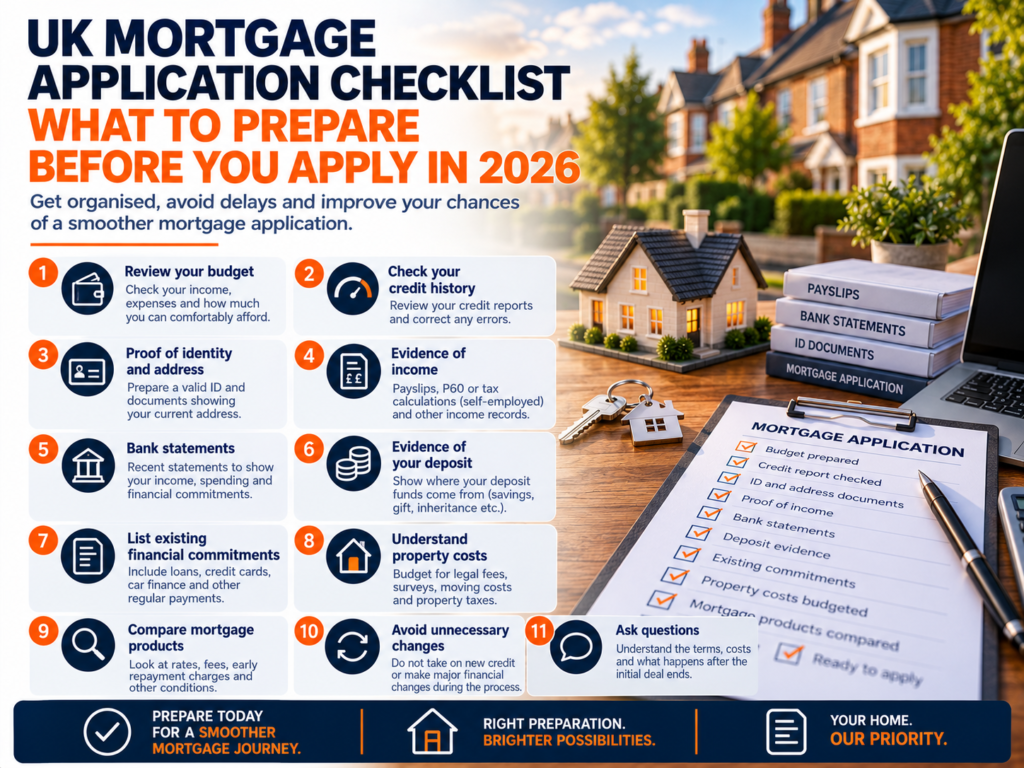

Applying for a mortgage is a major step towards buying a home or refinancing an existing property. Although the process can feel complicated, preparing your documents and reviewing your finances before applying can help make it more manageable.
Lenders need to assess whether you can afford the proposed borrowing and whether the property meets their requirements. They may review your income, expenditure, credit history, deposit, employment status, and other financial commitments.
Preparing in advance can help you identify potential issues early, reduce avoidable delays, and understand what you may be able to borrow.
1. Review Your Budget
Before approaching a lender, establish how much you can comfortably afford to spend on a property.
Start with your monthly income and subtract essential expenses, existing debt payments, regular bills, transport costs, food, insurance, and other commitments. Include a realistic allowance for property maintenance and unexpected expenses.
Do not base your budget entirely on the maximum amount a lender might offer. The lender’s affordability calculation may not reflect every personal priority or future cost in the way you would prefer.
Consider how your budget might change if interest rates rise after an introductory mortgage deal ends, your household income decreases, or your living expenses increase.
A sustainable mortgage payment should leave room for savings and ordinary life expenses rather than using every available pound.
2. Check Your Credit History
Your credit history can influence which mortgage products are available to you and how a lender assesses your application.
Before applying, review your credit reports with the relevant credit reference agencies. Check your personal details, financial accounts, payment history, and any recorded defaults or missed payments.
If you find an error, follow the agency’s process for correcting it. Resolving inaccuracies before submitting an application may help prevent confusion during the lender’s checks.
Try to maintain consistent payment habits and avoid taking on unnecessary new borrowing shortly before applying.
A lower credit score does not automatically mean that a mortgage is impossible. Different lenders have different criteria, and they may assess the severity, timing, and circumstances of past credit problems differently.
3. Prepare Proof of Identity and Address
Lenders must verify your identity and may require documents to confirm your residential address.
Depending on the lender, acceptable documents may include a valid passport, driving licence, or other approved identification, along with documents showing your current address.
The exact requirements vary. Make sure documents are valid, information is consistent, and copies are clear if you are submitting them electronically.
If your name has changed or your address history is complicated, prepare any supporting documents that may be needed.
4. Gather Evidence of Your Income
The documents required to verify income depend on your employment and the type of income you receive.
Employed applicants are commonly asked for recent payslips and bank statements. Some lenders may request a P60, employment details, or additional evidence of bonuses, commission, overtime, or other variable income.
If your income includes irregular payments, do not assume that every amount will be accepted in full. Lenders may use different methods to calculate qualifying income.
Self-employed applicants may need tax calculations, tax-year overviews, accounts, or other records covering an appropriate period. The required documents depend on the business structure and lender criteria.
Contractors, freelancers, and applicants with multiple income sources should establish the lender’s requirements before applying.
5. Organise Your Bank Statements
Bank statements help lenders understand your income, expenditure, and financial commitments.
They may review regular payments for loans, credit cards, childcare, subscriptions, rent, and other expenses. They may also ask questions about unusual transactions or large deposits.
Keep your financial records organised and be prepared to explain transactions accurately if requested.
Avoid moving money between accounts without keeping a clear record of the source and purpose. If your deposit includes a gift or money from an asset sale, retain relevant evidence.
Never hide financial commitments or provide misleading information. Accurate disclosure helps the lender assess your application properly.
6. Prepare Evidence of Your Deposit
Your deposit is the amount you contribute towards the property purchase rather than borrowing through the mortgage.
A larger deposit may reduce the loan-to-value ratio, which can affect the mortgage products available. However, you should not assume that a larger deposit automatically guarantees approval.
Prepare bank statements or other documents showing where the deposit funds came from. If the money has accumulated through savings, retain records that demonstrate this. If it comes from a gift, inheritance, investment sale, or another source, the lender or solicitor may request supporting evidence.
Gifted deposits often have specific requirements. The lender may ask who provided the funds, whether repayment is expected, and whether the person providing the money will have any interest in the property.
7. List Existing Financial Commitments
Make a clear record of outstanding loans, credit cards, vehicle finance, student loan deductions, maintenance payments, and other relevant commitments.
Lenders consider existing obligations when assessing affordability. The way a particular commitment is treated depends on the lender’s policy and the details of your circumstances.
Do not cancel or repay financial products without considering the consequences. For example, using all your deposit savings to clear a debt could leave you short of the funds required for the purchase.
If you are considering reducing debt before applying, calculate the effect on both your monthly budget and available deposit.
8. Understand the Property Costs
The deposit is only one part of the cost of buying a property.
You may also need to budget for legal fees, surveys, valuation costs where applicable, moving expenses, insurance, repairs, and property taxes such as Stamp Duty Land Tax in England and Northern Ireland when relevant.
Different tax rules apply in Scotland and Wales. The amount payable, if any, depends on the property, purchase price, and your circumstances.
If the property is leasehold, review the relevant lease terms and ongoing charges. Service charges and ground rent arrangements, where applicable, can affect your future budget and the lender’s assessment.
9. Compare Mortgage Products Carefully
Mortgage products differ in interest rates, fees, introductory periods, early repayment charges, overpayment allowances, and other conditions.
A low advertised rate does not necessarily mean the lowest overall cost. A product with a higher rate but lower fees may be more suitable in some circumstances.
Compare products over the period you expect to keep them, taking account of the total borrowing cost and any charges that may apply.
Also consider what happens when an introductory deal ends. If you do nothing, your mortgage may move to the lender’s applicable reversion rate, which could be higher than your original rate.
10. Avoid Unnecessary Changes During the Application
Once your application is underway, significant financial changes can affect the lender’s assessment.
Avoid taking on unnecessary new credit, changing employment without considering the implications, or making large unexplained transfers. If a major change is unavoidable, communicate honestly with the lender or adviser.
Do not assume that a decision in principle is a final mortgage offer. The lender may still need to verify documents, assess the property, and complete further checks.
11. Ask Questions Before Committing
Before proceeding, make sure you understand the mortgage term, interest rate, monthly payment, fees, early repayment charges, and any conditions attached to the product.
Ask what happens when the initial deal ends and whether you can make overpayments without a charge.
Prestige Mortgage Solutions Ltd may be a starting point for borrowers seeking mortgage guidance. Before engaging the firm, verify its regulatory permissions, service scope, fees, and the types of mortgage advice it provides.
Final Thoughts
A well-prepared mortgage application starts with accurate financial information, organised documentation, and a realistic budget.
Review your credit history, gather proof of income and deposit funds, list your commitments, and understand the wider costs of buying a property. These steps can help you approach the process with greater confidence.
This article is for general information only and is not personalised mortgage, financial, legal, or tax advice. Requirements vary by lender and individual circumstances.