
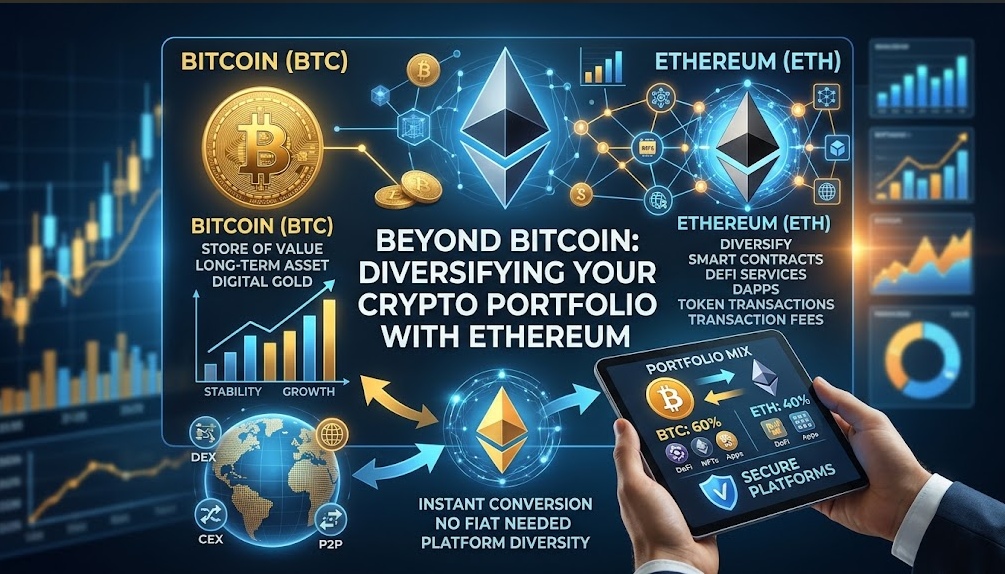

Holding only BTC in your portfolio is not always the best strategy; it is often better to select a mix of assets tailored to different objectives—for instance, by adding Ethereum. Unlike Bitcoin, which is primarily viewed as a long-term asset, ETH provides access to a different segment of the crypto market, including blockchain-based applications, token transactions, DeFi services, and network transaction fees. Digital currencies can be converted at any time without needing to cash out into fiat currency; this can be done via various platforms, such as cryptocurrency exchanges, P2P marketplaces, or dedicated exchange services. While the latter often offer distinct advantages, the prevalence of unreliable sites means that users must exercise great caution when choosing where to conduct their transactions.
Why Convert Bitcoin to Ethereum?
Converting BTC to Ethereum (ETH) is not just for those anticipating a rise in the price of ETH. Sometimes, the decision is driven by a specific need—for example, if one asset has already served its purpose in a portfolio, while another is required to interact with particular services or applications. In such cases, a conversion allows for the reallocation of capital without the need to withdraw funds to a bank account.
Converting Bitcoin to Ethereum (ETH) makes sense if:
- ETH is required to pay for transaction fees on the Ethereum mainnet, such as when interacting with smart contracts or decentralized applications (dApps);
- A Bitcoin holder decides to allocate a portion of their capital to another promising asset, thereby diversifying their holdings across cryptocurrencies with different characteristics and market demand drivers;
- An investor has re-evaluated the future prospects of Bitcoin versus Ethereum.
In all these scenarios, it is important to note that you do not have to convert your entire Bitcoin holding. For instance, if you only need ETH to cover network fees or a few specific on-chain operations, a small amount may suffice. Conversely, if the goal is to adjust the structure of an investment portfolio, you should determine the desired allocation for Ethereum in advance—while keeping in mind that the value of these assets will continue to fluctuate after the conversion.
When an exchange service is more convenient than a trading platform or P2P for converting BTC to ETH
You don’t need to master a full-fledged trading platform or engage in direct negotiations with a seller to convert Bitcoin (BTC) into Ethereum (ETH).
An exchange service is particularly advantageous in the following scenarios:
- You want to know the outcome in advance. An exchange service shows exactly how much ETH you will receive for a given amount of BTC, whereas on a trading platform, the final result depends on order execution and fees.
- You prefer not to navigate a complex trading interface. With an exchange service, you simply select the currency pair, enter the amount, and follow the instructions to complete the transaction.
- You need the ETH delivered directly to your own wallet. You provide the recipient address when submitting your request, eliminating the need for a separate withdrawal step from a trading account.
- You want to avoid the process of finding a counterparty and negotiating terms, as the exchange follows rules established by the platform.
- You wish to compare terms before sending your funds. Using an aggregator, you can view various offers for converting BTC to ETH, comparing exchange rates, available reserves, and the specific limitations of different platforms.
For a one-off conversion, using an exchange service is clearly simpler than relying on a trading platform or P2P exchange.
What to check before converting BTC to ETH
While different platforms may look similar, they often have different settlement rules, client requirements, and request-processing procedures. Therefore, you should choose a service based on how it handles your specific transaction, rather than just the appearance of its website. Key criteria to consider include:
- The final amount of Ethereum (ETH) you will receive, after accounting for all fees.
- Sufficient ETH reserves.
- Transaction terms—review the minimum and maximum exchange limits, payment deadlines, and policies for handling delays.
- Wallet and network compatibility—ensure that your wallet supports ETH on the specific network the service uses to send the funds.
- Platform reputation – look into reviews regarding successfully completed transactions, as well as recurring complaints about delays, exchange rate recalculations, or issues with refunds.
- Customer support – check whether it is possible to reach service representatives and receive assistance should a delay occur during a BTC-to-ETH exchange, or if a dispute arises.
The success of a transaction depends on your choice of exchange service, so it is important to analyze potential sites with due diligence.
Don’t miss out — discover more stories only on Meet Celebrity.